When your vehicle suffers minor body damage, you might hear the words "dent" and "crease" used to describe the imperfection. While they may seem interchangeable, in the world of auto body repair, they represent two distinct types of damage that require vastly different repair approaches. A dent is typically a round, concave impression where the metal has been pushed inward without sharp folds. Think of damage from a hailstone or a stray shopping cart. A crease, on the other hand, is a sharp, linear impact where the metal has been folded or gouged, often running horizontally or vertically across a panel. Understanding the fundamental difference between a rounded dent and a sharp crease is the first step in knowing what to expect from the repair process, including the techniques used, the time it will take, and the overall cost. This knowledge empowers you to have a more informed conversation with your repair technician.
The key distinction between dent and crease repair lies in the behavior of the panel's metal. A simple dent often stretches the metal uniformly, allowing skilled technicians to use methods like paintless dent repair (PDR) to gently massage it back into its original shape. A crease, however, damages the metal's "memory" by creating a hard fold, almost always cracking or scratching the paint in the process. This complexity means crease repair is a more involved procedure that typically requires traditional bodywork, including filling, sanding, and repainting to achieve a flawless finish.
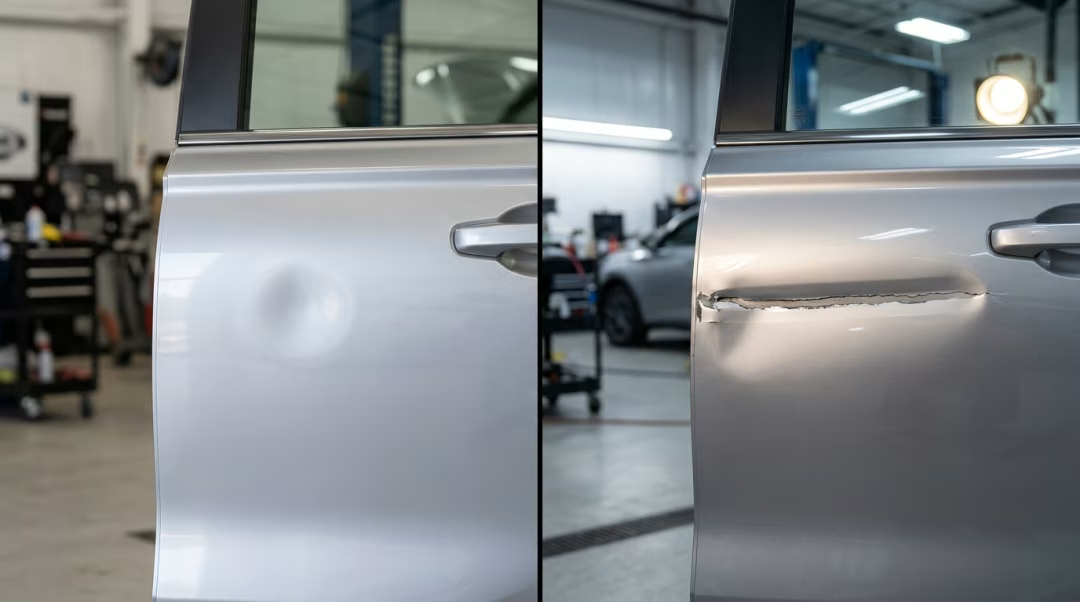
A dent is the most common form of vehicle body damage. It is characterized by a round or oval depression in a body panel where an object has impacted the surface. The edges of a dent are typically smooth, and the metal has been stretched but not sharply folded. The integrity of the paint is often, but not always, maintained.
Common causes of dents include:
The saving grace with many dents is a concept called "metal memory." Modern vehicle body panels are designed to hold their shape but also have a degree of flexibility. When a dent occurs, the metal is displaced, but it "wants" to return to its original form. This principle is the foundation of paintless dent repair (PDR). In a PDR process, a technician uses specialized tools to access the backside of the damaged panel. They then apply slow, precise pressure to manipulate the metal, carefully massaging the dent out until the panel is smooth again. The primary advantage of PDR is that it preserves the original factory paint, making the repair faster, more affordable, and less invasive than traditional methods. For information on how dings are handled, you can read our page on how door ding repair works.
A crease is a more severe and complex type of damage. Unlike the round depression of a dent, a crease is a sharp, linear indentation. It looks like a line or fold has been pressed into the metal. Creases occur when an object drags across the panel or when the impact comes from a sharp or narrow edge.
Common causes of creases include:
The defining characteristic of a crease is that the metal has been stretched to its breaking point and folded along a line. This action effectively destroys the metal's memory in that specific area. Furthermore, the sharp nature of the impact almost guarantees that the paint will be compromised—scratched, cracked, or scraped away entirely. Because of this, paintless dent repair is rarely a viable option for a crease. Attempting to push out a sharp fold with PDR tools would likely result in cracking the paint further or distorting the metal around the crease.
The repair process for a dent and a crease could not be more different. An experienced technician must first assess the damage to determine the proper course of action. If you are unsure what to expect, learning about what happens during a collision repair estimate can be helpful.
For a qualifying dent, the PDR process is preferred. It involves no sanding, no body filler, and no repainting. This keeps your vehicle's original finish intact, which is a significant factor in maintaining its resale value. The entire repair can often be completed in a few hours.
Crease repair, however, is a multi-stage process that falls under the umbrella of traditional collision repair. The steps generally include:
This comprehensive process for crease repair naturally takes longer and is more costly than PDR due to the labor and materials involved. For extremely severe creases, replacing the entire panel might be the more effective and economical solution.
While it may be tempting to self-diagnose the damage on your vehicle, only a trained auto body professional can provide an accurate assessment. They can identify the subtle nuances of the damage, such as whether it's located on a complex body line or near sensitive electronic components that might require recalibration. Choosing the right repair shop is vital for a quality result. When making your decision, consider factors like certifications, customer reviews, and the quality of their equipment. Getting a professional opinion ensures the correct repair method is chosen, restoring not only your vehicle's appearance but also its structural integrity and safety. To learn more about selecting the right facility, visit our guide on how to choose a collision repair shop.
It is extremely rare for a true crease to be repaired with PDR. If the crease is very soft, shallow, and has not broken the paint, a highly skilled PDR technician might be able to improve its appearance. However, in almost all cases, the sharp fold in the metal and associated paint damage make traditional body repair the only viable method for a complete restoration.
Yes, a crease repair virtually always requires repainting. The force and sharpness of the impact needed to create a crease will almost certainly crack, chip, or scratch the paint layer. To properly repair the folded metal underneath, the area must be sanded, filled, and primed, all of which necessitates a new application of color and clear coat to finish the job.
Yes, hail damage is the classic scenario for paintless dent repair. Hail typically creates numerous small, round dents without compromising the paint. This makes it an ideal candidate for PDR, which is far more efficient and cost-effective for repairing dozens or even hundreds of small dents than traditional methods. Learn more about how hail damage is assessed and repaired on our site.
Damage on a body line, which is a deliberate contour designed into a panel, complicates any repair. For a dent, it makes the PDR process more difficult as the technician must perfectly recreate the sharp factory line. For a crease, it requires exceptional skill during the body filler and sanding stages to restore the crispness of the line. Repairs on body lines are typically more time-consuming and expensive as a result.
A crease repair will only appear on a vehicle history report, such as CarFax, if an insurance claim was filed to pay for the repairs. If you pay for the repair out of pocket, the body shop has no obligation to report the work to any third-party vehicle history service. Therefore, the repair will not be documented on the report.