Even a seemingly minor collision can have a significant impact on your vehicle's wheel alignment. The kinetic energy from an impact does not just stop at the body panels; it travels through the car's entire structure, often jarring or bending critical suspension and steering components. Parts like control arms, tie rods, and even the vehicle's frame or subframe can be subtly knocked out of their precise factory specifications. This hidden damage is why your car might pull to one side, your steering wheel is crooked, or you notice uneven tire wear after a fender bender. Understanding these underlying causes is the first step toward a proper repair. A comprehensive inspection after any accident is crucial to identify and correct these issues, ensuring your vehicle remains safe and drives as it should. Neglecting alignment problems can lead to more expensive repairs down the road and compromise your safety on the road.
Proper wheel alignment is not just about extending the life of your tires; it is a fundamental aspect of your vehicle's safety and handling. After an accident, ensuring that the alignment is restored to factory standards is paramount. This process involves more than just a quick adjustment; it requires a thorough inspection of the entire suspension and steering system to check for bent or damaged parts. At our dealership, we understand the importance of a vehicle's history, which is why we meticulously inspect every car in our inventory to guarantee its structural integrity and performance.
When a vehicle is involved in a collision, the visible damage like dented fenders and broken headlights is often the primary focus. However, the forces at play can cause extensive, unseen damage to the intricate systems that keep your vehicle driving straight and true. Your car's alignment depends on a precise relationship between its suspension, steering, and frame. An impact can violently disrupt this delicate balance, leading to a cascade of issues. Understanding which components are most vulnerable can help you appreciate why a professional post-accident inspection is non-negotiable for your safety and the longevity of your vehicle.
The suspension system is designed to absorb road imperfections, but it is not designed to absorb the direct, concentrated force of a collision. It is often the first mechanical system to suffer damage that affects alignment.
Damage to any of these parts requires replacement, not just adjustment, to restore proper alignment and safe vehicle operation.
Your vehicle's steering system is directly linked to the front wheels, making it highly susceptible to damage that causes alignment problems. A crooked steering wheel after an incident is a clear sign that something is amiss.
The most severe cause of alignment issues stems from damage to the vehicle's core structure. On modern vehicles, this is typically the unibody, while on trucks it is a separate frame. This foundation is the mounting point for all suspension and steering components. If these mounting points are moved, even by a few millimeters, a perfect alignment becomes impossible. This is why a proper collision repair facility will take precise measurements of the entire vehicle structure. To learn more about this critical process, you can explore the signs your vehicle needs structural frame repair. Correcting this type of damage often requires specialized equipment for frame straightening to pull the structure back into its exact factory dimensions. Without this foundational repair, any attempt to align the vehicle will ultimately fail, as the wheels will be attached to a crooked base.
After any collision, you should be vigilant for the symptoms of poor alignment. Driving with these issues not only causes premature wear on your tires and suspension parts but can also be a serious safety hazard, as the vehicle may not handle predictably in an emergency maneuver. Pay close attention to the following warning signs:
If you notice any of these symptoms, it is essential to have your vehicle inspected by a qualified technician immediately. A thorough post-repair inspection that includes advanced diagnostic scans can uncover hidden damage that leads to these problems and ensure that all safety systems are functioning correctly.
Yes, absolutely. The force required to misalign suspension components is often less than what it takes to cause major body damage. Hitting a curb, a deep pothole, or having a low-speed collision can easily be enough to knock your vehicle's alignment out of specification, leading to tire wear and handling problems.
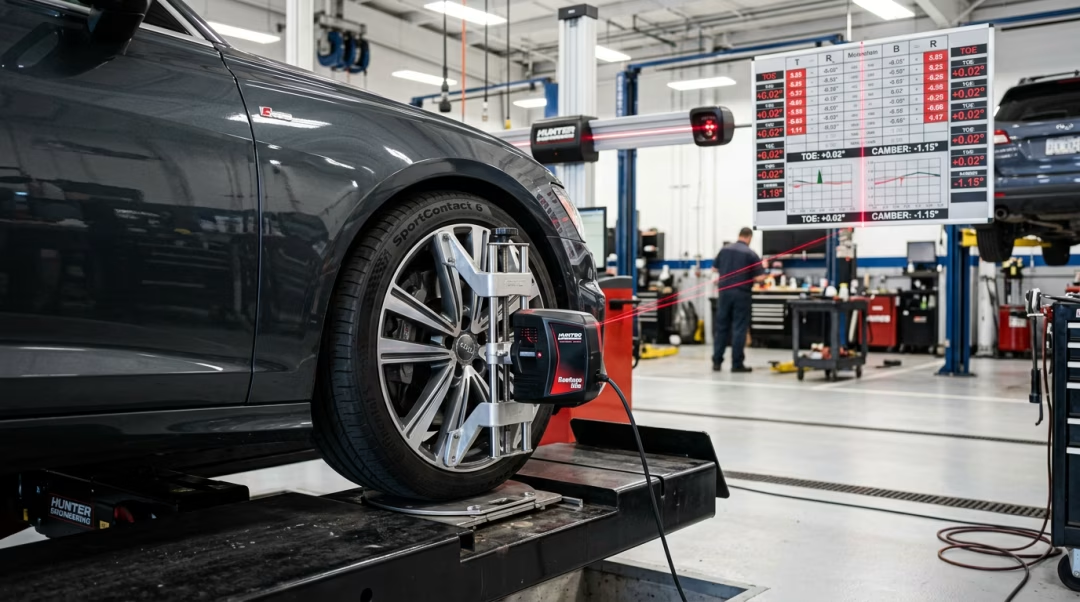
A proper post-collision alignment check uses a computerized alignment rack. This equipment uses lasers and sensors mounted on each wheel to measure the precise angles of the suspension (camber, caster, and toe) and compares them to the vehicle manufacturer's exact specifications. This is far more accurate than any visual inspection.
A two-wheel alignment, or front-end alignment, only adjusts the angles of the two front wheels. A four-wheel alignment measures and adjusts the angles on all four wheels. Most modern vehicles, especially those with independent rear suspension, require a four-wheel alignment for proper handling and to prevent tire wear on all four corners.
In most cases, yes. If you file a claim, the insurance company should cover the cost of an alignment check as part of the diagnostic process to assess the full extent of the accident's damage. If the check reveals that an alignment or parts replacement is necessary, that should also be covered as part of the comprehensive repair.
If no parts are bent or broken, a standard four-wheel alignment can take about an hour. However, if the inspection reveals that collision damage requires the replacement of components like tie rods, control arms, or struts, the repair time will be significantly longer, depending on the parts and labor involved.