Navigating an auto insurance claim can be a confusing process, and encountering unfamiliar terms like "betterment" only adds to the complexity. In the simplest terms, betterment is a cost that you may be asked to pay when a repair makes your vehicle objectively better than it was before the accident. The core principle of insurance is indemnity, which means restoring you to the same financial position you were in just before the loss, not a better one. When a covered repair requires replacing a worn-out part, like an old tire or a dying battery, with a brand-new one, the insurance company may argue that your vehicle's value has been enhanced. They will cover the cost of a replacement part with equivalent wear, and you are responsible for the difference in value, or the "betterment." Understanding this concept is key to managing expectations during your vehicle’s repair process.
It is important not to confuse betterment with your policy's deductible. A deductible is a fixed amount you agreed to pay out-of-pocket for any covered claim, regardless of the repair type. Betterment, however, is a separate, variable charge applied only when a new part replaces a worn component, increasing the vehicle's lifespan or value. While your deductible is a predictable part of every claim, a betterment charge is situational and depends entirely on the specific parts being replaced and their condition prior to the collision.
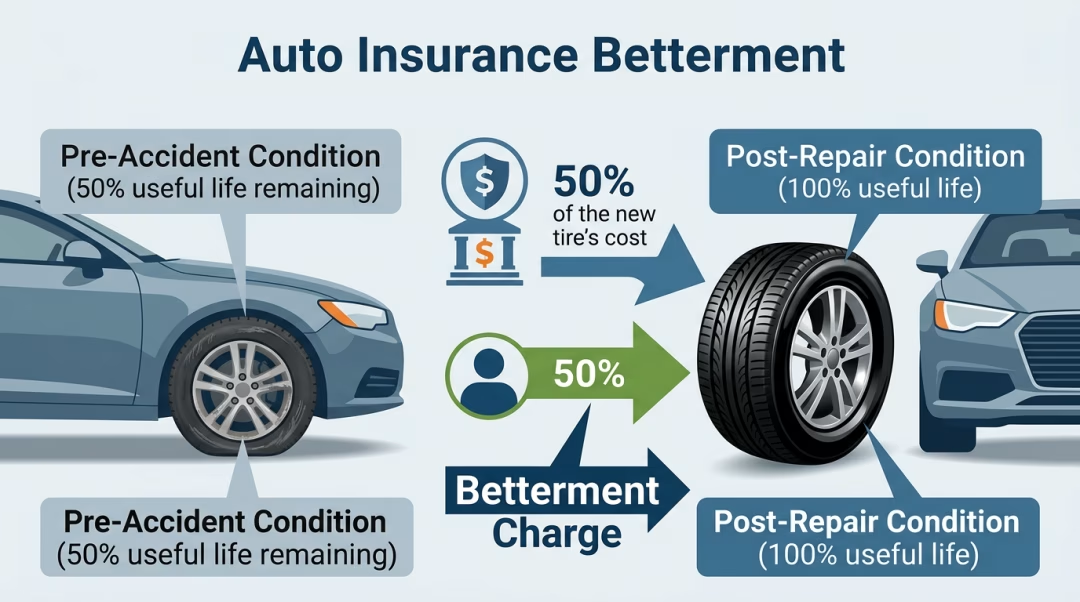
When you file an auto insurance claim, the goal is to have your vehicle restored to its pre-accident condition. The insurance company's obligation is to indemnify you, meaning they are responsible for covering the costs to make you "whole" again. However, the line can get blurry when dealing with parts that wear down over time. This is where the betterment clause, sometimes called the "depreciation" clause, comes into play. It is based on the idea that the insurer should not have to pay for the full cost of a brand-new part if the part being replaced was already nearing the end of its useful life.
Imagine your vehicle had tires with only 30% of their tread life remaining. If one is damaged in an accident, the repair shop will install a new tire with 100% tread life. Your insurance provider may argue that paying for the entire new tire would be an improvement, or betterment, of your vehicle's condition. Therefore, they might pay for 30% of the new tire's cost (the value of the old tire) and invoice you for the remaining 70%. This logic ensures they are only paying to replace what was lost, not to provide you with a free upgrade.
Betterment is not applied to every part of your vehicle. It is typically reserved for components that have a defined, predictable lifespan and are expected to be replaced periodically through normal use. These are often referred to as "wear-and-tear" items. While body panels, doors, and glass are not subject to betterment, you may encounter these charges for the following:
Insurance companies typically use a pro-rata or prorated formula to determine the betterment amount. The adjuster will assess the remaining useful life of the damaged part. This is often based on mileage, age, or physical evidence of wear. For a tire, they might measure the remaining tread depth. For a battery, they might consider its age relative to its warranty period. For instance, if a battery has a 5-year warranty and it was 4 years old at the time of the accident, it had 20% of its useful life left. The insurer would cover 20% of the cost of a new battery, and you would be responsible for the remaining 80%. When you read your collision repair estimate, any betterment charge should be clearly itemized and explained.
Yes, you can and should question any betterment charge you believe is unfair. The key is to provide evidence that the insurance adjuster's assessment of the part's remaining life is inaccurate. Start by asking the adjuster to justify their calculation in writing. How did they determine the percentage of wear? You can counter their assessment with your own documentation, such as recent service records showing the part was in good condition or photos taken before the accident. If you recently replaced the tires, provide the receipt. If your mechanic can attest to the condition of the suspension or brakes, a written statement can be powerful. A reputable collision repair center can also be a valuable ally, as they can provide a professional opinion on the pre-accident condition of the damaged components.
State regulations regarding betterment vary, so it is also wise to check with your state's Department of Insurance to understand the laws that apply to your policy. Some states have specific rules limiting how and when betterment can be applied.
In some cases, the combination of extensive repair costs and significant betterment charges can influence an insurer's decision to declare a vehicle a total loss. Each state has a total loss threshold, which is a percentage of the vehicle's actual cash value (ACV). If the estimated cost of repairs exceeds this threshold, the vehicle is totaled. Because betterment charges are part of the overall claim cost, high charges on an older vehicle can be the final factor that pushes the estimate over the limit. If you find yourself in this situation where your car is deemed a total loss, it can be an opportunity to start fresh. You can use the settlement from your insurance company to find a reliable pre-owned vehicle. It is a good time to explore our extensive inventory of quality used cars or find out what your damaged vehicle might be worth by using our value my trade tool to see how it can help you get into your next car.
Yes, betterment is a legal and standard practice in the insurance industry. It is based on the principle of indemnity, which is fundamental to insurance contracts. The practice prevents policyholders from profiting from a loss by ending up with a vehicle in a better condition than it was pre-accident at the full expense of the insurer. However, the application of betterment is often regulated by state laws, so specific rules can vary by location.
You cannot simply refuse to pay a legitimate betterment charge, as it is your portion of the repair cost under your policy. However, you absolutely have the right to dispute the amount. If you believe the insurer's assessment of the part's prior wear is incorrect, you should provide evidence like maintenance records or a mechanic's statement to negotiate a more accurate and fair charge.
No, betterment is not applied to parts that do not have a defined lifespan of wear and tear. This includes body panels (like doors, fenders, and hoods), bumpers, and the vehicle's paint job. The expectation is that these components should last the entire life of the vehicle, so replacing them with new OEM parts is considered a direct restoration of pre-accident condition, not an improvement.
To determine if a betterment calculation is fair, request a detailed breakdown from the insurance adjuster explaining how they arrived at the percentage of depreciation. Compare their assessment with your own knowledge and records of the vehicle. For example, check your tire purchase receipts for mileage warranties and compare that to your current mileage. Consulting with your trusted auto body technician for a professional opinion can also provide leverage in negotiating a fairer amount.
No, they are very different concepts. Betterment is a cost you pay when a repair improves your vehicle's condition. In contrast, a diminished value claim is a claim you can make against an at-fault driver's insurance company for the loss in your vehicle's resale value, even after it has been perfectly repaired. Betterment is about the value of individual parts, while diminished value is about the overall market value of the vehicle itself.